Disciplining Freud on Religion by Kaplan Greg; Parsons William; Belzen Jacob
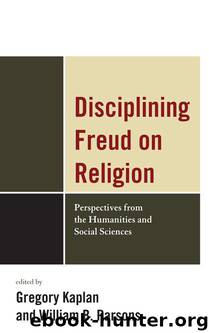
Author:Kaplan, Greg; Parsons, William; Belzen, Jacob [Kaplan, Gregory]
Language: eng
Format: epub
Publisher: Lexington Books
Published: 2010-01-01T05:00:00+00:00
Discovering that there is no ontological core to consciousness or self that is independent and enduring and no stable “objects” of perception . . . no “I” or “thing” enduring across the gap between one construction and arising of the next—this is a profound shock. It is experienced as a free fall into a looking-glass world where, as the Mad Hatter tells Alice, “Things are not as they seem!” It so turns our normal sense of self and reality on its head that, as Niels Bohr once remarked about quantum physics . . . if you don’t get dizzy thinking about it, you haven’t understood it.36
For Engler psychoanalysis and Theravada Buddhist employ different techniques for different aims. Free association, dream interpretation, transference etc., are all fruitful ways of heightening introspection and deepening the awareness of the discontents of repressed thoughts and feelings. But vipassana is designed to heighten attention to the extent that one is able to retrace the representational process whereby a sense of self, world, and other come to exist. In its most profound sense the practice of vipassana leads to the above description of anatta: the insight into the absence of an enduring self. If the therapeutic task can be conceived along the lines of mourning, the psychoanalytic encounter with Buddhism now reveals that the latter engages an even deeper level of mourning and working through: that of the existence of a continuous, stable, enduring self. The consequences of this perspective for psychoanalytic understandings of self and healing are dramatic. Engler proposes the radical claim that the construction of a separate, enduring, continuous self is “a compromise formation with defensive aims.”37 In other words, we repress the fact of an unconstructed core to existence. Indeed, Engler is quick to point out that the insight into anatta is not necessarily a discovery. From the Theravadin Buddhist perspective, the common-sense understanding that an enduring self exists is an illusion. There never was a self to begin with.
Of course Engler’s is not the only attempt to account for the More of Buddhism. One could, for example, note the work of Paul Cooper who, banking off Ignacio Matte-Blanco’s revisionist formulations of the unconscious, argues that Koan activity unearths the deepest dimensions of the unconscious, characterized as the “indivisible mode” where total symmetry prevails, or Judith Blackstone who, in engaging formulations of non-self states and their relation to conceptions of self-other found in intersubjective theory, argues that the former “goes beyond” the latter in the claim, central to Mahayana and Vajrayana strands of Buddhism, that there exists a Buddha nature within: a nonorganized self-existing nondual ground.38 These conceptions of the “not-self” differ, and it is important to note that while Engler is allied with Theravada Buddhism, Cooper is a practitioner of Zen and Blackstone hails from lineages within Tibetan Buddhism. Indeed, Blackstone explicitly takes on Jack Engler and Mark Epstein, both of whom she thinks represent what the Tibetan Buddhist Rinpoche Tsultrim Gyamtso refers to as the Rangtong understanding of Self. In
Download
This site does not store any files on its server. We only index and link to content provided by other sites. Please contact the content providers to delete copyright contents if any and email us, we'll remove relevant links or contents immediately.
Unwinding Anxiety by Judson Brewer(73393)
The Art of Coaching by Elena Aguilar(53609)
The Fast Metabolism Diet Cookbook by Haylie Pomroy(21243)
Rewire Your Anxious Brain by Catherine M. Pittman(18791)
Healthy Aging For Dummies by Brent Agin & Sharon Perkins RN(17117)
Talking to Strangers by Malcolm Gladwell(13519)
The Art of Thinking Clearly by Rolf Dobelli(10700)
Mindhunter: Inside the FBI's Elite Serial Crime Unit by John E. Douglas & Mark Olshaker(9502)
Crazy Rich Asians by Kevin Kwan(9409)
The Compound Effect by Darren Hardy(9143)
Tools of Titans by Timothy Ferriss(8579)
Periodization Training for Sports by Tudor Bompa(8411)
Becoming Supernatural by Dr. Joe Dispenza(8361)
Wonder by R. J. Palacio(8226)
Bodyweight Strength Training by Jay Cardiello(8026)
Crystal Healing for Women by Mariah K. Lyons(8000)
Change Your Questions, Change Your Life by Marilee Adams(7921)
Nudge - Improving Decisions about Health, Wealth, and Happiness by Thaler Sunstein(7844)
Therapeutic Modalities for Musculoskeletal Injuries, 4E by Craig R. Denegar & Ethan Saliba & Susan Saliba(7778)
